
Rethinking Metrics of Academic Success:
Historically, academic achievement has been predominantly measured by quantitative metrics such as the number of publications, citation counts, and journal impact factors, reflecting a long-standing emphasis on scholarly output [1]. Many researchers are familiar with the phrase ‘Publish or perish’, which reflects the academic pressure one faces to publish papers while preparing others in the pipeline to secure jobs and grant funding. As the Indian research landscape expands and global focus shifts towards innovation-driven economies, it prompts a critical reevaluation: Should research impact be solely measured by publications?
Beyond “Publish or Perish”: Redefining Research Impact:
Several government initiatives, such as funding programs and innovation hubs, have been established to encourage researchers to translate their laboratory discoveries into practical technologies, thereby bridging the gap between research and market application. One such initiative is ‘Start Up India.’ According to government records, more than 1,80,000 start-ups have been recognized under this scheme as of late 2025 [2].
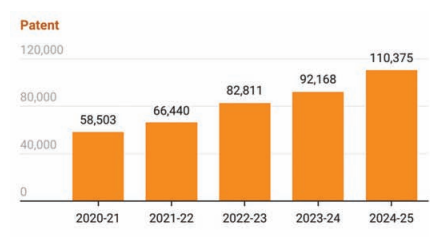
Figure 1: Trends in the last five years with respect to the filing of patent applications [2]
This number indicates the substantial progress in our country’s innovation. These start-ups include Affordable cancer cell therapy by ImmunoACT (2018), Seaweed-derived renewable bio products by Sea6 energy (2010), Solar and wind energy generation by ReNew Power (2011), Chemical extraction and recycling solutions by Poly Protic (2023). In such a competitive and innovation-driven research environment, patents play a critical role in protecting individual discovery. For researchers and institutions aiming to contribute to national development, patents provide an important pathway for converting scientific ideas into products, processes and technologies that benefit society.
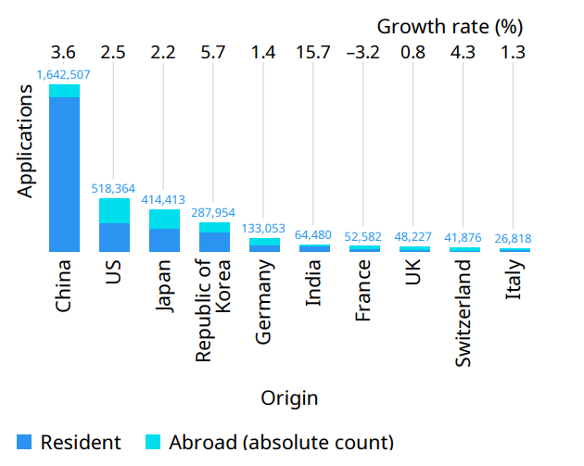
Figure 2: Patent applications for the top 10 origins, 2023 [3]
From Patent Applications to Granted Innovations:
According to the 2024 global reports from the World Intellectual Property Organisation (WIPO), India recorded more than 64,000 patent applications in 2023, placing it among the top countries worldwide and highlighting one of the fastest growth rates among major economies. [3]
However, not every scientific discovery immediately translates into a commercial product. Many innovations require novelty, years of further research, funding and collaboration before they become viable technologies. According to the annual report by the Intellectual Property of India (2024-2025), India received 110,375 patent applications, of which 15,726 were examined. The Patent Office granted 33,504 patents, while a total of 40,606 applications were disposed of, including patents granted, refused and applications abandoned or withdrawn by applicants.[4]
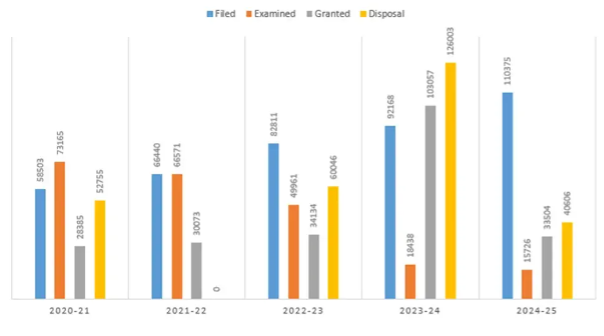
Figure 3: Trends in patent applications from 2020 – 2025 [4]
While patents are gaining prominence in the innovation landscape, they complement rather than diminish the critical role of publications in disseminating scientific knowledge. Publications and patents play different but complementary roles in scientific progress. Publication enables scientists to share their ideas with the public, allowing other scientists to reproduce them and advance the field. Technologies such as semiconductor electronics and drug development were not initially designed for commercial purposes. Patents protect innovations and facilitate technology transfer, enabling their development into products and services that benefit humanity.
Towards a balanced framework of Research Impact:
The actual challenge for India is not to choose between patents and publications, but to build a system that values both. Basic research is necessary to advance science and technology, and patents and technology transfer facilitate their translation into practical applications. Interacting with and strengthening ties between industry, academia, and startups can help translate scientific innovations from the lab to the market. As India strengthens its presence in the global science and technology arena, it is imperative to develop comprehensive metrics that encompass both scholarly contributions and practical innovations, ensuring a balanced evaluation of research impact. Supporting both publications and patents can ensure that the research not only contributes to scientific knowledge but also to the growth of the country.
Reference