
Author: Rayavarapu Padmavathi, PhD
Former Postdoctoral Fellow, Drexel University, USA.
Editor: Paramita Sakar, PhD
Postdoctoral Fellow, NIDCR/NIH, Bethesda, USA.
Before the advent of in-vitro fertilization (IVF), countless women endured the silent anguish of
infertility, often believing that the creation of new life was beyond their reach despite rapid
scientific progress. This perception began to shift in 1959, when researchers first achieved
successful fertilization and development of embryos in a laboratory setting, marking a pivotal
moment in reproductive science and opening the possibility that human conception outside the
body might one day become achievable.
The development of IVF was far from instantaneous. It was the culmination of decades of
rigorous research, perseverance, and scientific innovation. From the retrieval of oocytes to
fertilization outside the human body, carefully mimicking physiological conditions and
subsequent embryo transfer, each step required precision and dedication. This relentless
pursuit led to a historic breakthrough in 1978 with the birth of the world’s first IVF babies: Louise
Brown, born in July under the work of Steptoe and Edwards (1,2) , and Durga, born in October
through the pioneering efforts of Dr. Subhash Mukhopadhyay (3). While these breakthroughs
transformed reproductive medicine, the lived experience of IVF remains deeply personal and
emotionally complex.
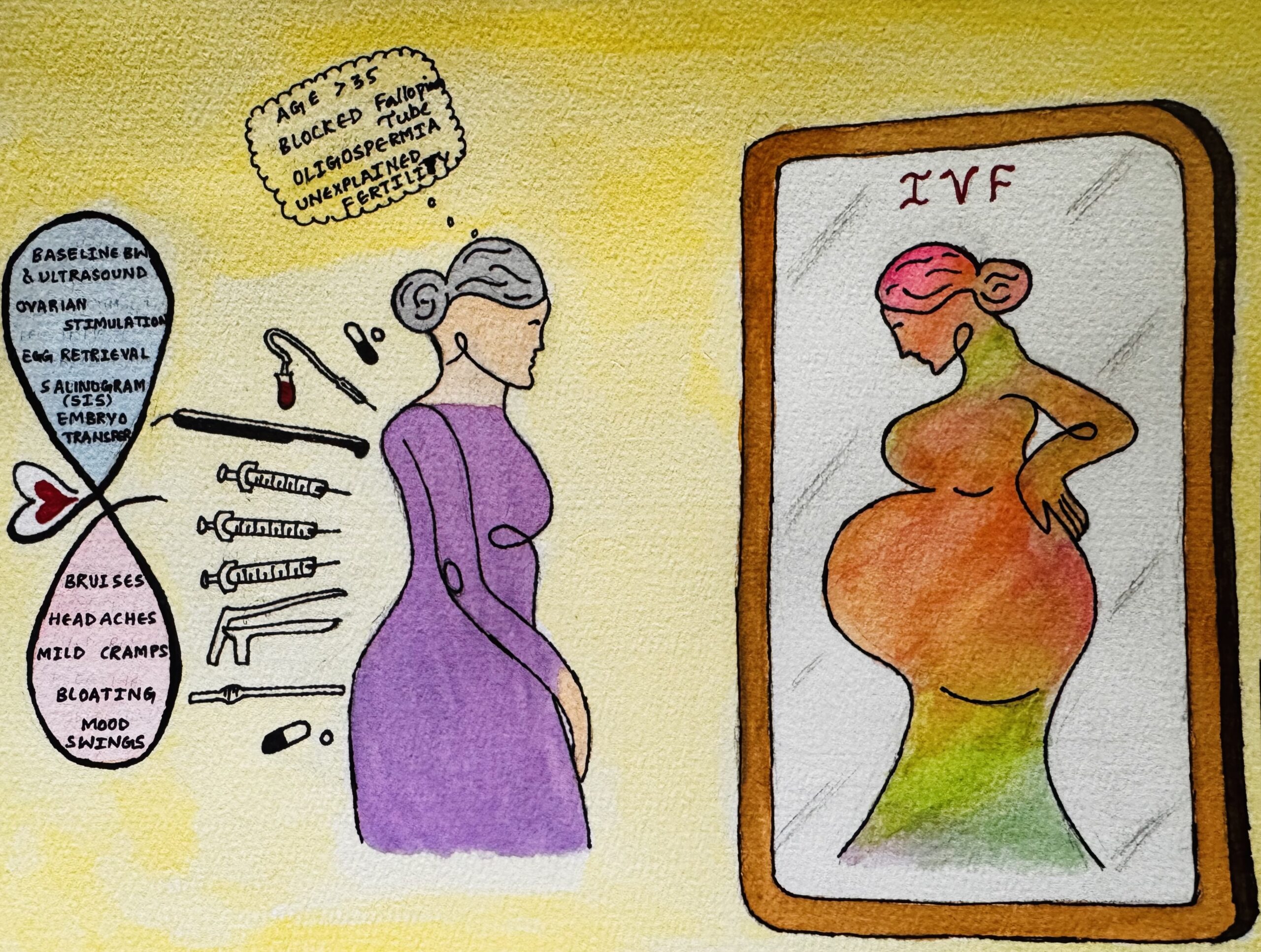
The artwork presented here captures the silent and often overwhelming journey of IVF – a path
filled with both physical endurance and emotional resilience. A woman appears weighed down,
her thoughts crowded with medications, injections, and medical procedures. The journey begins
with extensive baseline investigations, including blood tests and transvaginal ultrasounds. This
is followed by a demanding regimen of hormonal injections such as gonal-F and menopur,
designed to stimulate the growth of multiple ovarian follicles (4,5) . Trigger injections are then
administered to induce ovulation before egg retrieval is performed through a minor surgical
procedure.
What follows is a period of anxious waiting. Despite retrieving multiple eggs, only a fraction
successfully progresses through fertilization and embryonic development. Prior to embryo
transfer, procedures such as a saline infusion sonogram ensure that the uterine environment is
suitable for implantation (6,7,8) . Even after transfer, the journey continues with hormonal support,
particularly progesterone, to sustain early pregnancy (9) .
The process demands resilience through bruises from injections, fatigue, hormonal fluctuations,
mood swings, and physical discomfort (10,11) . An infinity loop subtly ties together pain and hope,
suggesting that this journey, though cyclical and demanding, is driven by an unending desire for
life and love. In many ways, this reflects the essence of motherhood – enduring pain,
uncertainty and hope in pursuit of new life. Yet even successful conception marks only the
beginning of another demanding journey culminating in childbirth.
Although the cost of IVF varies widely across countries and the path is often physically,
emotionally, and financially challenging, it has enabled the birth of millions of children worldwide
(12) . For many, IVF is not just a medical procedure; it is the embodiment of hope, transforming the
dream of creation into reality.
References:
1) Steptoe, P. C.; Edwards, R. G. Birth after the reimplantation of a human embryo. The
Lancet. 1978, 312 (8085), 366.
2) Edwards, R.G; Bavister, B.D.; Steptoe, P.C. Early stages of Fertilization in vitro of human
oocytes matured in vitro. Nature, 1969, 221 (5181), 632-635.
3) Kumar, T.; C.; A. Architect of India’s first test tube baby: Dr Subhas Mukerji (16 January
1931 to 19 July 1981), Curr. Sci, 1997, 72 (7), 526-531.
4) Schats R, Smitz J, Andersen AN, et al. Ovarian stimulation during assisted reproduction
treatment: a comparison of recombinant and highly purified urinary human FSH. Hum
Reprod. 2000;15(8):1691-1697.
5) Smitz J, Andersen AN, Devroey P, Arce JC; MERIT Group. Endocrine profile in serum
and follicular fluid differs after ovarian stimulation with HP-hMG or recombinant FSH in
IVF patients. Hum Reprod. 2007;22(3):676-687.
6) Gera PS, Allemand MC, Tatpati LL, Galanits TM, Morbeck D, Coddington CC. Role of
saline infusion sonography in uterine evaluation before frozen embryo transfer cycle.
Fertil Steril. 2008;89(3):562-566.
7) Sigalos G, Triantafyllidou O, Vlahos N. How do laboratory embryo transfer techniques
affect IVF outcomes? A review of current literature. Hum Fertil (Camb). 2017;20(1):3-13.
8) Seshadri S, El-Toukhy T, Douiri A, Jayaprakasan K, Khalaf Y. Diagnostic accuracy of
saline infusion sonography in the evaluation of uterine cavity abnormalities prior to
assisted reproductive techniques: a systematic review and meta-analysis. Hum Reprod
Update. 2015;21(2):262-274.
9) Posaci C, Erten O, Camlica H, et al. Progesterone supplementation in IVF and embryo
transfer cycles: the role of progesterone in maintaining early pregnancy. J Assist Reprod
Genet. 2000;17(2):96-101.
10) Verhaak CM, Smeenk JM, Evers AW, van Minnen A, Kremer JA, Kraaimaat FW.
Women’s emotional adjustment to IVF: a systematic review of 25 years of research.
Hum Reprod Update. 2007;13(3):245–255.
11) Boivin J, Griffiths E, Venetis CA.Emotional distress in infertile women and failure of
assisted reproductive technologies: meta-analysis. BMJ. 2011;342:d223.
12) Adamson GD, de Mouzon J, Chambers GM, et al. Global estimates of assisted
reproductive technology births. Fertil Steril. 2025;124(1):40–50.